Download our App now!
Talk to India's top Astrologers
Login
You will receive a 4 digit code for verification
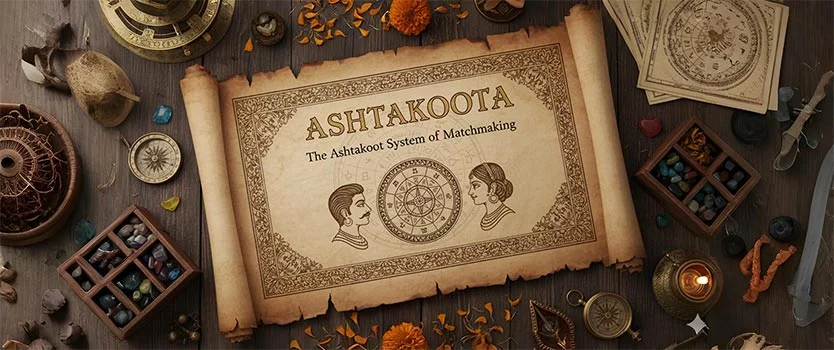
The Ashtakoota system evaluates marital compatibility through eight distinct astrological factors derived from the Moon sign of both partners. Since the Moon governs emotions, instincts, and mental responses, its placement becomes central in determining how two people relate to each other after marriage. Over centuries, Ashtakoota Guna Milan has guided families in making informed marital decisions rooted in astrological wisdom.
The term Ashtakoota is formed from two Sanskrit words—Ashta, meaning eight, and Koota, meaning divisions or categories. Together, they represent eight astrological considerations used to measure compatibility between a prospective bride and groom.
These eight kootas are calculated based on the Janma Rashi (Moon sign) of both individuals. Each koota reflects a specific aspect of married life, such as emotional understanding, mental harmony, physical attraction, temperament, and progeny-related indications. Rather than focusing on temporary attraction, Ashtakoota emphasizes long-term marital balance as indicated by planetary placements.
Because the Moon reflects subconscious behavior and emotional reactions, its role in Ashtakoota matching becomes highly significant. This is why Moon-based matching remains deeply respected in Vedic marriage astrology.
Marriage introduces shared responsibilities, emotional dependence, and lifelong companionship. From an astrological perspective, this bond functions smoothly only when planetary energies support cooperation and understanding. Ashtakoota matching helps astrologers assess whether these energies align naturally between two charts.
Some important reasons why Ashtakoota is given importance include:
When the Gunas align favorably, married life flows with fewer emotional disturbances. Even if challenges arise, compatible charts indicate better adjustment capacity, especially when supported by a free janam kundli analysis that reveals deeper planetary influences. For this reason, Ashtakoota matching is traditionally performed before marriage discussions move forward.
Each koota carries a fixed number of points, adding up to a total of 36 Gunas. Let us understand each one clearly.
Varna Koota reflects spiritual maturity and mutual respect. It indicates whether both partners support each other’s inner growth and belief systems.
Vashya Koota shows how one partner influences the other. Balanced Vashya ensures cooperation rather than dominance in married life.
Tara Koota examines health, longevity, and overall well-being. A favorable Tara match supports stability and protection from repeated obstacles.
Yoni Koota represents physical compatibility and instinctive behavior. It plays a role in marital comfort and intimacy.
Graha Maitri focuses on planetary friendship between Moon lords. This koota strongly influences communication, trust, and shared understanding.
Gana Koota reflects personality traits such as calmness, ambition, or intensity. Proper Gana alignment allows emotional balance in daily interactions.
Bhakoot evaluates emotional bonding, family harmony, and financial stability. Certain Bhakoot combinations are examined carefully due to their impact.
Nadi Koota holds the highest weight. It relates to genetic compatibility, childbirth prospects, and long-term health patterns.
The combined score of all eight kootas determines the Guna Milan result.
| Koota | Life Aspect | Maximum Gunas |
|---|---|---|
| Varna | Spiritual inclination | 1 |
| Vashya | Mutual influence | 2 |
| Tara | Health and longevity | 3 |
| Yoni | Physical compatibility | 4 |
| Graha Maitri | Mental harmony | 5 |
| Gana | Temperament | 6 |
| Bhakoot | Emotional bonding | 7 |
| Nadi | Progeny and health | 8 |
| Total | — | 36 Gunas |
A score of 18 or more is generally considered acceptable. However, experienced astrologers never rely on numbers alone. They also examine planetary placements, Doshas, and Dasha periods before giving final guidance, often through a free astrology chat that allows deeper discussion and personalized interpretation.
In today’s time, marriages involve career pressures, emotional expectations, and changing lifestyles. Despite these changes, Ashtakoota matching remains relevant because emotional alignment and mental stability remain timeless needs.
Even when certain kootas show weakness, planetary cancellations and remedies are considered. Many marriages succeed when charts indicate mutual understanding, even with moderate Guna scores.
Ashtakoota continues to guide marriage decisions through astrological wisdom rooted in the Moon’s influence. It does not predict happiness directly, but it indicates compatibility, adjustment capacity, and emotional rhythm between two individuals.
When interpreted by a knowledgeable astrologer, Ashtakoota Guna Milan becomes a meaningful guide rather than a rigid rule, especially when discussed through an online astrology consultation. Combined with communication, patience, and mutual respect, it supports the foundation of a stable and balanced married life.
Tags : #Astrology
Author : Hardik
Facing delays in marriage, job issues, or relationship doubts?
Connect with expert astrologers for instant and accurate predictions.
 Chat with Astrologer
 Talk to Astrologer
 Book a Puja